Why environmental justice movements must confront militarism and empire
Article written by Kelly Anissa, Friends of the Earth Asia-Pacific
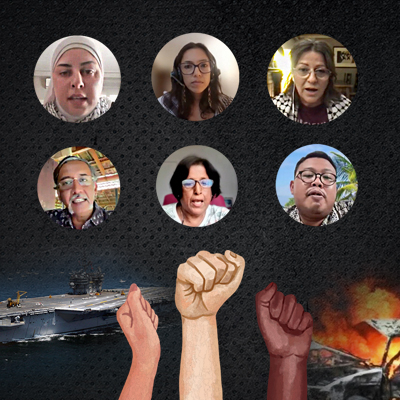
In light of the growing escalation of violence across West Asia, from the ongoing genocide in Palestine to the attacks on Iran, environmental justice movements across the Asia-Pacific came together to reaffirm a truth that has long guided our struggles: environmental justice cannot be separated from questions of war, militarism, sovereignty, and liberation.
For many years, movements have spoken about the connections between ecological destruction, extractivism, colonialism, and economic exploitation. Yet the scale of violence unfolding today demands renewed clarity and collective action. The destruction of lives, communities, and ecosystems across the region is not occurring in isolation. It is part of the same systems of power that drive climate breakdown, resource extraction, land dispossession, and inequality.
In response to these developments, Friends of the Earth International and allied movements issued a collective position condemning militarism, imperial aggression, and the ongoing devastation inflicted on people and the planet. For many in our network, this marked an important moment of political unity: a shared commitment to speak out together against the interconnected crises threatening communities across the Global South.
To deepen these conversations, Friends of the Earth Asia Pacific convened a webinar bringing together movement leaders and environmental justice advocates from across the region. The discussion explored how war, militarism, ecological destruction, and economic domination are deeply intertwined—and why building a just and sustainable future requires confronting all of them together.
Imperialism is not history
Setting the stage for the discussion, Meena Raman of Sahabat Alam Malaysia/FoE Malaysia traced the roots of today’s crises to the enduring structures of imperialism that continue to shape political, economic, and ecological realities across the Global South.
While many countries won formal political independence decades ago, Meena argued that systems of economic domination remain firmly in place through international financial institutions, unequal trade agreements, sanctions, and geopolitical pressure. She highlighted how sovereignty continues to be undermined through economic coercion, regime change, and policies that limit countries’ ability to determine their own development paths.
The consequences extend beyond economics. Cultures, knowledge systems, and local solutions are routinely sidelined in favour of development models imposed from outside. At the same time, the environmental costs of these systems are borne disproportionately by communities across the Global South, which continue to suffer the worst impacts of a climate crisis they did little to create.
“This is the lived reality of imperialism. It is not history – it is here, now”.
Her presentation concluded with a call for movements to strengthen solidarity across struggles, oppose militarism, and defend the right of peoples to determine their own futures.
Palestine: environmental justice under occupation
Building on these reflections, the discussion turned to Palestine, where the intersections of militarism, environmental destruction, and colonial domination are starkly visible.
Rasha Abu Dayyeh from Friends of the Earth Asia Pacific highlighted how communities across the regions represented in the webinar face common challenges – including extraction, displacement, militarisation, and unequal access to resources – but noted that Palestine represents one of the most acute manifestations of these dynamics.
The destruction of infrastructure, contamination of land and water, displacement of communities, and ongoing siege conditions demonstrate how environmental harm functions alongside broader systems of violence and control. Yet despite these realities, Palestinian communities continue to resist through organising, documenting environmental damage, defending their territories, and advocating for justice. Rasha stressed:
“Environmental justice in Palestine cannot be separated from questions of sovereignty, dignity, survival, and collective liberation.”
The discussion underscored that ecological recovery requires not only reconstruction, but also accountability, justice, and the protection of civilian life.
When war reaches everyday life
Vijayan MJ of Friends of the Earth India brought the conversation closer to home by examining how geopolitical conflicts directly affect communities throughout the Global South.
Using the recent escalation involving Iran and disruptions around the Strait of Hormuz as an example, he demonstrated how global energy politics shape everyday realities for ordinary people. He noted that countries across the Global South are frequently expected to comply with sanctions regimes and geopolitical agendas determined elsewhere, despite bearing the economic consequences.
For South Asia, he argued, developments in Palestine, Iran, and West Asia cannot be understood as distant foreign affairs. The impacts of war are ultimately felt through rising fuel prices, inflation, debt pressures, and increasing costs of living. As supply chains become unstable and energy prices rise, it is working people, farmers, fisherfolk, migrants, and small businesses who absorb the costs first.
“This is why the question of Palestine, Iran and West Asia is not ‘foreign policy’ for South Asia. It is about food, fuel, debt, labour, climate and survival.”
His talk highlighted how militarism and geopolitical conflict are inseparable from the everyday economic struggles faced by communities across the region.
Ecological justice requires a redistribution of power
Turning to pathways forward, Wahyu Eka Setyawan of WALHI/Friends of the Earth Indonesia challenged participants to imagine solutions rooted not in extraction and profit, but in ecological justice and community control.
He outlined the need for energy systems that are fully renewable and controlled by communities, food systems grounded in sovereignty and agroecology, and stronger protections for Indigenous peoples’ rights and territories.
Importantly, Wahyu pointed to existing examples that demonstrate the viability of these alternatives. Through WALHI’s community governance framework, more than 1.1 million hectares of land across Indonesia are currently managed by communities, supporting over 161,000 households through collective stewardship, land rights protection, and Indigenous ecological knowledge.
These initiatives offer a glimpse of what a different future could look like: one built around people rather than profit. But achieving that future requires more than technological change; it requires a fundamental redistribution of power and the protection of environmental defenders who continue to face criminalisation, violence, and intimidation.
“Ecological justice is not only about protecting nature. It is about protecting people, securing rights, and ensuring a livable future for the next generation.”
His contribution served as a reminder that genuine climate solutions already exist within communities and movements across the region.
A feminist lens on war and empire
Closing the discussion, Sam Castro of Friends of the Earth Australia invited participants to examine militarism and genocide through a feminist lens.
She argued that the systems driving violence against communities and ecosystems mirror the dynamics of gender-based violence: domination, coercion, control, gaslighting, and impunity. Drawing parallels between interpersonal abuse and state violence, Sam challenged participants to recognise how patriarchal power operates across multiple scales; from individual relationships to global systems of empire.
Pointing to the use of gendered and sexual violence in conflict, alongside broader patterns of militarisation and control, she emphasised that environmental justice movements must understand ecological destruction not only as an environmental issue, but also as a manifestation of oppression and patriarchal violence.
“All war is patriarchy in motion and genocide is the most extreme manifestation of violence and abuse of patriarchy”.
Her presentarion called for feminist pathways that centre care, liberation, accountability, and collective resistance as essential components of environmental justice.
Building movements beyond silence
Across the webinar, a shared message emerged: environmental justice cannot be achieved while systems of militarism, colonialism, and imperial domination remain intact.
Whether through war-driven ecological devastation, the criminalisation of environmental defenders, economic coercion, or the displacement of communities, these systems are deeply interconnected and mutually reinforcing.
The speakers reminded us that environmental justice is not only about emissions, technologies, or conservation. It is about power. It is about who controls land, energy, food, knowledge, and futures.
At a moment when violence continues to escalate across the region, silence is not an option.
The task before our movements is not only to resist environmental destruction but also to challenge the structures that produce it. From Palestine to Indonesia, from India to Malaysia, from grassroots communities to international solidarity networks, the call is the same: oppose militarism, defend sovereignty, protect people and planet, and build futures rooted in justice.
Watch the full webinar here.