—
We’re here with Andrés Muñoz from Friends of the Earth Spain [1] to discuss the characteristics and consequences of industrial livestock farming, as well as a landmark court ruling in Galicia stemming from a lawsuit over pollution from industrial livestock farms in the Limia River and the As Conchas Reservoir.
Andrés, how are you? Thank you so much for taking the time to speak with us.
Thank you very much for inviting me.
Andrés, we’d like to start by giving a general overview of industrial livestock farming. What are the characteristics of this type of livestock production?
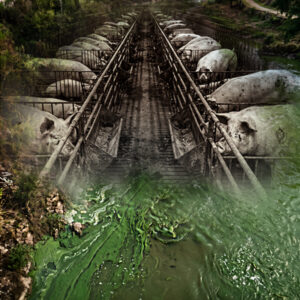
In Spain and Europe, we don’t have an official definition of what industrial livestock farming is, but environmental organisations like ours that oppose this model have identified characteristics common to what we call industrial livestock operations or “macro-farms.” The first characteristic of these industrial macro-farms is that they concentrate large numbers of animals confined in a very small space.
Another characteristic is that all, or most, of the feed provided to the animals is not produced on the farm itself and must therefore be brought in from outside. Most of these livestock farms use concentrated feed that must be sourced from outside, generally relying on the international market, and the production of this feed also generates social and environmental impacts.
Another characteristic of these farms is that they use large quantities of antibiotics, which are administered to the animals to prevent diseases caused by the high density in which they are kept. This too has environmental and social impacts. There is also a high level of specialisation. Given the procedures they follow, we can therefore describe this as an industrial activity rather than an agricultural one.
These are farms that do not have enough land to expand or spread the manure produced by these animals, which also has enormous consequences. Finally, the last characteristic and perhaps the most defining one from an economic and social standpoint is that these are vertically integrated operations, at least as is generally the case in Spain and many European countries, where the owners of the meat processing companies also own the animals, the feed, and the antibiotics. Therefore, they set the price, so the role played by livestock farmers is very limited.
Can you tell us what the most significant consequences of these farms are? At the micro level, how might this affect individuals and communities? And at the macro level, how might it affect the global situation?
To categorise it in some way, we could first highlight the impacts that this livestock activity is having on the region, in Spain, and in Europe in terms of negative environmental impacts. They consume enormous amounts of water to supply these animals. At the same time, they pollute the water, because these large-scale operations generate vast amounts of livestock waste manure and slurry which contaminate the soil when spread over small areas in enormous quantities, ultimately polluting underground aquifers and rivers as well.
There is also massive air pollution because this waste produces ammonia, which has a huge impact—not just in terms of odour. We usually distinguish between environmental and health impacts, but we know that when we pollute the environment, we are polluting the surroundings in which we live, and that affects people’s health. Water pollution has enormous health impacts; scientifically speaking, nitrate pollution contributes to the spread of a vast number of diseases, including various types of cancer.
Administering such large quantities of antibiotics (to animals) also has repercussions for human health, because we are creating antibiotic resistance, and when we get sick, we can’t find antibiotics that can cure us. When there are concentrations of nitrate-contaminated water, cyanobacteria also proliferate, causing further health impacts.
I would add that people living in rural areas where these mega-farms have proliferated on a massive scale have to endure living in places with unbearable odours and swarms of flies. They cannot open their windows or engage in activities outside their homes. They are subjected to a tremendous amount of noise from the constant traffic of trucks transporting animals or feed for these animals. In short, the socio-environmental impacts are enormous and not just in Spain.
The reliance on importing feed from other countries to feed these animals because in the case of Spain and Europe as a whole, we cannot produce enough feed ourselves (e.g. genetically modified corn or soybeans used to make animal feed) also has socio-environmental impacts in those other countries, many of which are in the Global South, such as those in Mercosur, Brazil, Argentina, Uruguay and Paraguay which are suffering from the industrialised production of genetically modified corn and soybeans, with impacts on local populations due to pollution and monoculture farming associated with this activity.
And in terms of climate change, are there any associated impacts?
We all know that the industrial-scale production of genetically modified corn and soybeans has enormous impacts. Deforestation in areas like the Amazon and other forested regions is increasing as these areas are cleared for industrialised production. At the same time, this also accelerates international trade in raw materials, specifically raw materials used for animal feed, and boosts international trade in the export of meat that is not consumed in the country where it is produced. Furthermore, we know that industrial livestock farming is one of the main sources of greenhouse gas emissions.
Among the major struggles of Friends of the Earth Spain and Friends of the Earth International [2] is food sovereignty. How are these issues connected? Why can we say that large-scale livestock operations are a barrier to achieving food sovereignty?
What we see here in Spain, in Europe, and I believe this is a pattern that occurs in other regions as well, is that industrial livestock farming is not determined at the local level. Producers and livestock farmers do not make decisions about this activity; they have no autonomy when industrial livestock farming is in operation.
What we see here, for example, is that public policies and the interests of the meat industry are driving the proliferation of a huge number of macro-farm industrial livestock operations throughout Spain, primarily in our case for industrial pork production. The farmers who supply this meat industry have no decision-making power. They receive the animals and the feed to raise them; the selling price of the animals is set for them, and they cannot decide anything. Instead, they are subject to enormous pressure and significant financial risk because they are the ones who have to make the financial investment to set up the operation and have no decision-making power whatsoever.
We understand that this type of activity prevents small-scale farmers and ranchers from deciding for themselves what kinds of food they have and, at the same time, for what purposes. This is because most of the industrial meat production in our country and in Europe does not even remain within the territory; it is destined for third countries. As a result, we are left with the environmental and social impacts of this activity, yet we receive neither the majority of the production nor the economic benefits.
Therefore, this activity in no way represents the values of food sovereignty, that is, the right of communities to freely decide how to produce and consume food in ways that make sense, that connect with their cultural values and the resources of their territory, and that generate social value and wealth.
What impact does this type of production have in Spain?
It is the main problem we face in Spain, which is why both Friends of the Earth Spain and Friends of the Earth Europe [3] are supporting the fight against industrial livestock farming, because it has an enormous impact and significance in the struggle for land in rural areas.
Let’s keep in mind that in Spain, over the past 70 years, there has been a massive migration of people from rural areas to large cities, and yet there is still a large rural population. However, there is a perception that rural areas are what we call “sacrifice zones”, where all the resources there must be at the service of capital, large corporations, and urban populations. This perception includes industrial livestock farming in small villages with sparse and rapidly ageing populations where mega-farms are being established that absorb all the region’s resources, pollute the aquifers, and prevent the people living in these villages from drinking the water they traditionally drew from their rivers.
Within that framework, and suddenly now with the ongoing energy crisis, it has also been decided that we need to boost biogas production—which requires organic matter—and what better source than livestock waste? So now we’re installing biogas plants right next to those mega-farms, in those communities. The main impacts are felt in rural areas that we call “empty” or “depopulated.”
Let’s talk about the specific case of As Conchas in Galicia, because it’s a paradigmatic case that sets a very important precedent. Can you give us a summary of what happened at the reservoir and how the case ended up in court?
As Conchas is a reservoir that’s about 70 years old, a large reservoir built to store water for electricity generation, and it was a major attraction for the entire surrounding population in the La Limia region of Galicia, in northern Spain. It served as a recreational area and a hub for local community life, especially in the summer.
Starting in the 1990s, industrial livestock farming began to proliferate with increasing intensity in the area, driven by a local company. The number of farms continued to grow, and by early 2000, test results began to show pollution levels in the reservoir caused by manure and nitrate flowing down the Limia River, which feeds the reservoir. Some local organisations began alerting government agencies that a pollution problem was developing.
The truth is that in the 20 years since warnings about this situation first began, public authorities have done nothing and the situation has continued to worsen because the number of large-scale livestock farms in the area has increased to the point where the water is so contaminated with nitrates and cyanobacteria that the laboratory analyses and expert reports we have show that it is unsafe to swim in the water or to be near the reservoir, given the health effects it also causes.
So two years ago, some organisations such as Friends of the Earth, ClientEarth, and a consumer association like CECU decided to support people in the affected communities. Seeing that the authorities were doing nothing, we decided to file a lawsuit alleging a violation of fundamental rights.
This is the first lawsuit of its kind filed in Spain and in Europe, and it was successful. We have managed to prove that industrial livestock farming and its effects have resulted in a violation of fundamental rights enshrined not only in the Spanish Constitution but also in the Charter of Fundamental Rights of the European Union. A violation of the right to health; a violation of the right to private property, because these people’s homes have lost value due to pollution; and a violation of the right to enjoy the environment, because they live in areas that are so degraded they can no longer make use of them.
And we hope this ruling will also serve as a precedent so that in other parts of Europe facing similar situations, people can demand that the authorities restore the environment to its original state.
Here you can find a series of short videos produced by Friends of the Earth Spain featuring testimonies about the case.
Beyond the victory for rights and the social and political victory that comes from setting a precedent and demonstrating that industrial livestock farming does indeed pollute and violate rights in practical terms, what does this ruling mean?
The sentence mandates that the regional administration as well as the state government, which is responsible for managing the river, restore the reservoir to its original condition. But not only that. It also requires them to regulate and control livestock farming to such an extent that the court even states they must establish a moratorium. This means that no new livestock operations may be authorised in the area until the situation is reversed. It also requires them to conduct a comprehensive environmental assessment of pollution, something they have not done so far.
So, for us, it is of immense value for a court to establish a moratorium, because this is the policy demand we have been advocating for at least the past 10 years at the national level since the number of livestock farms and the number of animals raised in our country for industrial livestock production continue to increase every year. In fact, Spain is currently the world’s third-largest producer of pork, trailing only China and the United States.
While other countries like Germany have been reducing the number of livestock farms and animals, whether due to social pressure, greater environmental awareness, or the realisation that the industry isn’t profitable enough, we have continued to feed this monster. Perhaps the only way we have right now to stop it is through court rulings like the one in As Conchas.
Friends of the Earth is part of a coalition called Stop Industrial Livestock [4]. So, in that regard, and to wrap up this interview, what proposals or alternatives might there be to industrial livestock farming? Are there possible ways to produce food using alternative methods?
In 2018, we at Friends of the Earth decided to support dozens of neighbourhood coalitions that were springing up across the country to fight against the large-scale industrial livestock operations moving into their municipalities. We believed it was important to help them organise at the national level so they could spread the message about how crucial it was to rethink the model and establish a moratorium that would allow us to pause, assess the impact it was having, and determine where we wanted to go as a country.
Over the past year, we’ve extended that same experience to the European level. Together with Friends of the Earth Europe and other organisations in the European Federation, we’ve established a platform at the European level as well, because we see that the problem isn’t confined to any single country. Rather, it’s a model that’s driven by public policies at the European level, and there are corporate interests that aren’t tied to a single country but move from one country to another depending on their interests. Yet the problem and the model are the same, and we need to coordinate our efforts at the European level as well.
At Friends of the Earth Spain and Friends of the Earth Europe, we oppose the industrial livestock model, but we also have a series of proposals—not just opposition to that model. We believe it is essential, first and foremost, to reduce the consumption of meat and animal protein in our regions, because consumption is very high and has been driven by public policies. 50 years ago, our culinary tradition did not include such large amounts of meat.
Second, we advocate for much more sustainable meat production—extensive livestock farming rooted in the local landscape, where farmers can raise animals in open spaces, feeding them with grass and forage that the land can provide, which also generates enormous environmental benefits.
Let’s consider, for example, that it’s summer in Spain right now—every summer we suffer from a huge number of wildfires, and they’re becoming increasingly larger and more destructive. One of the measures we advocate for at Friends of the Earth—and for which there is growing awareness—is the importance of extensive livestock farming in preserving these rural areas and preventing wildfires.
Andrés Muñoz of Friends of the Earth Spain, thank you very much for your time and for sharing all this information and the knowledge you’ve accumulated.
Thank you very much to all of you.