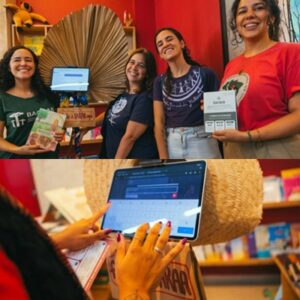
A few weeks ago in Brazil, IARAA—an Artificial Intelligence tool for Agrarian Reform and Agroecology—was launched. The tool was developed by the Landless Rural Workers’ Movement (MST) and the World March of Women (WMW) and supported by the Baobab International Association for People’s Cooperation in China.
To discuss this, I’m joined by Natalia Lobo, an activist with the World March of Women. Natalia, what was your role in the development of IARAA?
Last year, I attended the artificial intelligence course for Global South movements in China, where the WM W and the MST participated alongside other movements. That’s where the idea to develop IARAA was born. Since then, I’ve been working alongside my colleagues to develop the tool technically and to identify and select agroecology materials that form the basis of IARAA’s knowledge base.
Does this idea address a need that existed among farmers and agricultural workers?
We, the World March of Women and the MST, have agroecology as part of our agenda for struggle. We are organised in rural areas with women and men who work the land, and one of their most pressing demands was to have access to the agroecological knowledge that our movements and organisations have developed over many years—knowledge that is scattered or sometimes presented in language that is not simple enough for people to understand. Therefore, we know there are many obstacles—political and otherwise—to making the agroecological transition and building agroecology, but it is true that farmers’ access to this knowledge was one of those obstacles. Thus, IARAA is an effort to overcome this barrier and make the accumulated knowledge from our organisations and research institutions—which we trust and rely on—available to the people.
In practical terms, how does the tool work?
IARAA is a chatbot on the Baobab website. It works like other language models we use in our daily lives—as a text window where you can ask questions and the AI agent responds. There, you can ask questions about agroecology in broad terms—including agroecological practices, how to apply agroecology in the field and in the production of animals, plants and food—covering the entire production process. You can also ask questions about the political aspects of agroecology, the history of agroecology and the organisation of movements in this field.
It functions as a chatbot specialising in grassroots agroecology.
And how does it differ from the most well-known, corporate, or dominant artificial intelligence models that currently dominate the web?
There are many differences. IARAA is entirely based on what we call our knowledge base. It’s like a library that we—the members of the movements—have built with the help of activists who serve as our guides in agroecology. Ever since we returned from China and began this process, we’ve been building this vast library that contains practical, theoretical, and political knowledge about agroecology.
IARAA works exclusively with this knowledge base. Therefore, it will not access information on the internet—information that, for example, may have been posted by agribusinesses and may reflect a perspective on agroecology or organic agriculture that we do not share. It is entirely based on the materials we select and relies solely on them to respond to people.
If someone asks a question and our library doesn’t have any information on that topic, IARAA will say it can’t answer and will direct the person to public agencies or social movements to access that information. This is unlike commercial language models, which always give you an answer, often a misleading one.
IARAA also applies its own line of reasoning when formulating responses, incorporating many political elements that are key to our movements. For example, whenever someone asks a question related to the economy—whether it involves aspects of labour organisation or the organisation of the rural economy—IARAA uses feminist economics as its framework for understanding the economy. So, it will discuss women’s labour; it will lead the person to ask where the life-sustaining labour lies in this situation and how to organise labour and the economy in a way that puts life at the centre.
It will also always encourage people to seek collective solutions and to work collectively. It does not view agroecology as a discipline isolated from others, but rather takes a more systemic and holistic view of agroecosystems. If someone asks a very specific question, it can provide a specific answer, but if someone asks how to organise production in a broad sense, IARAA will always take a broad view of the agroecosystem and the integration of different forms of production and labour within it. These are key elements for us in thinking about agroecology. Of course, there are some limitations, but there is also great potential, and we manage to incorporate that into the way IARAA formulates its responses.
How does it manage data and privacy? And what does it mean for it to be open source?
Being open source means that we use open-source tools to develop IARAA. For the language model, we currently use DeepSeek, which is an open-source model that has many limitations, but for now, it’s the best model we’ve been able to access. We use this and other software in the IARAA development process—all open-source tools. It’s not a black box; we know how they’re developed and can even modify how they work.
It is a practical tool but also a tool for political struggle, aimed at building digital sovereignty in our countries and in the Global South. Part of this struggle is also advocating for the state and the public sector to invest in the development of public and open-source technologies. Our goal is that one day we will be able to use a language model from Brazil that is public, developed by a public university, and open-source, which would be closer to the political project we believe needs to be built. However, we see IARAA as a tool on this path of construction, so we decided not to wait for all the ideal conditions to begin creating our tool, but rather to start with what we have—and even use these contradictions and limitations to highlight the need to fight along this path to build the alternatives we want.
Let’s talk about the political significance of IARAA. Why is it necessary to start developing grassroots digital technologies and to sidestep or resist the Big Tech companies, even if we don’t yet have all the knowledge or the perfect tools?
We share an analysis—one held by many organisations and sectors of the left—that Big Tech companies are the most powerful expression of capitalism today. They are the transnational corporations that hold the most power in their hands, perhaps in history. They pose threats to democracy, to the exploitation of nature and human labour, and they are a major threat to humanity and the political project we want to build. It is therefore urgent to build alternatives to this power and to organise resistance against it.
This is a new agenda for our organisations, which have always prioritised issues such as building food sovereignty, grassroots feminism and democracy. Technological sovereignty is a relatively new concept, but the current political climate has put us in a position where we must put this issue on our agenda and work toward this struggle to build the anti-capitalist society we envision.
This is based on the experience in China, which is a society where technology is highly advanced—in some respects even more so than in the United States—but with a different approach to technological development. Technology is developed under public control and serves the people in their daily lives. We draw great inspiration from this experience, which shows us that it is possible to develop technology and have more of it—but in a way that ensures technology serves the people, improves their lives and does not exploit people or nature, nor drive people from their lands.
We need to build this in our own countries and regions, tailored to our specific circumstances—which, for thousands of reasons, will not be the same as the Chinese model—but it is an inspiration that leads us to begin imagining, building, and fighting for our own alternatives and our technological sovereignty to combat the immense power of Big Tech in our lives and to create tools that improve people’s lives.
How has IARAA been received? Have there been any discussions or evaluations since its launch?
The reception has been very positive overall. I think IARAA has reframed the debate on artificial intelligence (AI) in our political sphere here in Brazil. I believe that in our field, the view on AI used to be more defensive, opposed to AI and purely critical. I think there are many reasons why people hold this position. It’s a very valid stance in many ways because in our region, in Latin America, the technologies we use and the way technology is designed follow the U.S. model—we use U.S. technology and U.S. social media platforms. We suffer all the impacts this has on our lives, from the arrival of data centres to the threats to democracy posed by social media.
I believe that IARAA plays an important role in emphasising that it’s crucial for us to also have proposals and to know what we don’t want, but we need to have a clear vision of what we do want: what kind of technology do we want, and what is possible to build in this field? And we shouldn’t act as if it were a lost battle, nor behave as if AI weren’t already a reality in our lives, because it certainly is.
When we visited rural communities, the farmers were happy to see IARAA, and one thing they mentioned was that their young people already use language models like ChatGPT all day long. So if we have our own tool—one based on our politics and our way of better understanding agroecology— IARAA is also serving as a tool for political education through popular education within our movements.
So, alongside the IARAA development process, we hold training sessions on the topic, and that’s where people bring up their concerns. For example, there are areas here in Brazil that are heavily impacted by data centres, and during these sessions, we can discuss what a data centre is and why it has to be so big. What happens there? What are the data processing models we want to advocate for? What is technology that supports life? We’re against this model of large data centres that consume water and energy, but as we work to build technological sovereignty, how do we envision it? What will it look like—more decentralised, smaller?
We’re also beginning to develop proposals and the capacity to be active participants in this debate, even vis-à-vis the Brazilian government through social participation processes. So, IARAA is a very limited, very small tool, but I think the most important thing is that it’s responsible for initiating a political process in our field.
Are there any plans to internationalise the tool or share experiences in other countries and territories?
Yes, we’ve begun a dialogue with a farmers’ organisation in Ghana that’s going to develop a tool very much based on IARAA, but more specialised in cocoa production—a major crop for farmers there who expressed great interest in having IARAA and in having the tool developed locally to better understand and support cocoa production.
I think the idea is to build an internationalist agenda for technological sovereignty with more organisations, including through training. And if IARAA is a tool that will support more people, there’s this idea of internationalising it, but also of supporting people in creating their own tools, because perhaps IARAA won’t provide the answers to everyone’s problems. So, perhaps it’s not so much about internationalising the tool, but rather internationalising the struggle and this collective understanding of the politics and technology of AI to support people in creating their own tools around the world.
Natalia, to wrap up the interview, I’d like to ask you a question related to the World March of Women and the feminist movement: Why is it important for technological sovereignty to be part of the feminist movement’s political agenda?
One thing we saw a lot of in Brazil was the dissemination of images of naked women generated by AI without their consent. This made it very clear—even in people’s daily lives—that the rise of Big Tech is closely tied to patriarchy and the violation of women’s bodies.
This was common in Brazil—many women had their bodies violated through the use of these tools—and although we know that these tools are harmful to the lives of women and communities, this case makes everything very obvious, very clear. It’s very obvious that these tools have the capacity to restrict this type of use—that is, to refuse to produce non-consensual nude images of women when someone tries to use AI to do so. They could clearly say no, that they cannot produce this type of image, even if they have the technical capability to do so. But we know that Big Tech chooses to reproduce images that violate women’s rights because it guarantees them profit, and that is a very lucrative aspect of their business model.
They have absolutely no commitment to women’s lives, and this is very clear in our day-to-day lives. And this isn’t just about the use of AI to create images or social media, but the entire development model of Big Tech—from infrastructure onward. The first people affected when a data centre arrives in a rural area, for example—which happens a lot here in Brazil—are women whose subsistence farming is disrupted, who no longer have access to water for the work of sustaining life, and whose domestic and care work is increased by this situation.
The same thing happens with mining, with energy companies, with any transnational corporation that moves into a territory. We know that the people most affected and at the forefront of the struggles are women, and this is happening more and more now with data centres and everything that Big Tech companies represent in terms of a threat to democracy—their ties to the far right and conservatism. As political actors, they support the perpetuation of patriarchy, conservatism and capitalism. They are currently the main actors in this project.
So for us, building technological sovereignty is a necessary feminist struggle, and we also have to think about how to develop technology for women, to improve women’s lives. In this regard, we face a great challenge, many great challenges. But one very significant one is that women are not present in technology; they are not key players in technology development. Technically, they are a minority in this field as workers, and this is a space that is concentrating more and more power and becoming increasingly masculinised. When women aren’t involved in the design and development of technologies, those technologies won’t serve women’s lives or their safety, nor will they help reduce, for example, the levels of violence women face on the streets. Technology could be a great ally in this process, but that is not what is happening. This kind of use of technology is not being prioritised.