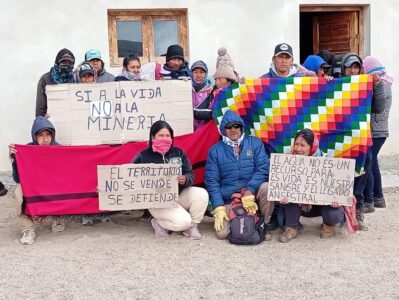
The Diaguita Indigenous people are native to northwestern Argentina and have ancestrally inhabited lands located in what are now the provinces of Catamarca, Salta, Tucumán and La Rioja. They maintain their traditional way of life, based on high-altitude herding, the exchange of goods and subsistence farming. They live at an altitude of 4,000 metres and rely on glacial water. Their territory is their identity.
For several years, mining projects have been attempting to expand into their mineral-rich territories, particularly in search of copper. Provincial governments and the Ministry of Mining have opened the doors to these companies, granting them permits while failing to conduct free, prior and informed consultation, a right of Indigenous Peoples recognised by the United Nations and the International Labour Organization, and an obligation undertaken by the Argentina and its provincial governments. And when communities resist, the authorities send in the police to repress them.
The Diaguita communities of Peñas Negras (Catamarca) and Jasimaná (Salta) have filed a collective environmental protection lawsuit before Argentina’s federal courts.
The legal action challenges mining permits granted without consultation and calls for the suspension of mining prospecting activities (specifically for the Aguas Calientes I, II and III projects), the protection of water sources and an end to police harassment.
Speaking to Real World Radio, Andrea Morales Leanza, legal representative of the Peñas Negras community and adviser to the Union of Peoples of the Diaguita Nation of Catamarca, said:
“The territory and this type of activity are incompatible. These are high mountain and puna regions, where water is scarce, with glaciers and periglacial areas, their own wildlife and a unique geography. That is why this area is considered a World Heritage Site. These are high-Andean lagoons that require special protection and are covered by specific legislation.”
The lawyer also explained that the latest mining expansion, aimed at mineral exploitation, involves the companies Elevado Gold (Australian-owned) and Amalaya, operators of the Millaray mining company, and is taking place in Ramsar sites, territories protected under national environmental legislation because of their ecological importance and biodiversity.
The problem is not only the open-pit mining method, similar to that used at the Alumbrera mine, also located in Catamarca and opposed by residents of Andalgalá [1], but also all the infrastructure it entails and the use of water. Most seriously, it threatens to displace Diaguita communities.
“These are remote communities where the State has never had a presence. And when it does appear, it comes alongside mining companies and in a violent manner,” Morales Leanza explained.
Although mining-related violence and violations of Indigenous rights have a long history in the area, the situation worsened in 2021, when the Peñas Negras community refused to allow mining permits on its territory. According to the legal representative, this marked the beginning of the criminalisation of community members.
The first serious incident was an arrest warrant issued against the chief of the Peñas Negras community, a direct attack on the community and its organisation. This marked the beginning of what would become systematic persecution, resulting in hundreds of people facing baseless accusations.
This year, mining companies once again attempted to force their way into the territory to advance several mining projects, accompanied by pro-mining groups and provincial police. Despite being at a significant disadvantage, the communities resisted and faced harsh repression.
“We are urgently requesting a precautionary, preventive injunction to put an end, above all, to institutional violence,” the lawyer stressed.
Today, the Peñas Negras community remains in permanent assembly and has raised all alarms. Community members have suspended their regular activities, their community ties are deteriorating, and they are living in fear. For this reason, Morales Leanza explained, “the legal action seeks not only to protect the environment, but also the mental health of community members.”
The lawyer pointed out that the authorisation processes for mining prospecting were riddled with administrative and legal irregularities. “It is important to publicly denounce how the State and provincial governments operate, particularly the government of Catamarca under Governor Raúl Jalil, and how multinational companies such as Elevado Gold operate with a complete lack of ethics.”
While expressing hope that the legal action will bring some peace of mind and allow the community to reorganise its life, Morales Leanza said that the fundamental debate “is not about mining: yes or no.” “It is about how we envision the world and how we want to relate to those who have inhabited it ancestrally,” she reflected.
Images: ANRed [2]
If you would like to learn more, we recommend reading Peñas Negras vuelve a defender su territorio frente al avance minero [3] by Tierra Nativa – Friends of the Earth Argentina, and Peñas Negras: la comunidad diaguita sitiada, amenazada y sin respuesta ante el avance minero [4] by ANRed.