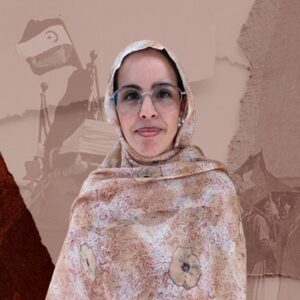
Jadiya Alí Mohamed was born in 1993 and grew up in one of the five refugee camps located in southwestern Algeria, where the first Sahrawis were expelled following the illegal occupation of their territories by Morocco and Mauritania in 1975, and the subsequent war with the Polisario Front, forcing them into exile.
With Morocco’s construction of successive walls separating the occupied territory from the lands held by the Sahrawi Arab Democratic Republic, Jadiya has never met many of her close relatives in person. Today, she is part of the National Union of Sahrawi Women and takes the struggle for a free Western Sahara wherever she goes.
In an interview with Real World Radio* Jadiya calls for greater international pressure on Morocco, particularly from the Spanish people, since Spain withdrew from Western Sahara in 1975 without completing the decolonisation process and is still recognised by the United Nations (UN) as the administering power of that territory.
Since then, a referendum in Western Sahara has been pending so that the population can decide whether or not they want an independent state.
“It is a contradiction for Morocco to claim that Western Sahara belongs to them while sitting in the African Union, where the Sahrawi state is also represented.”
“We are two completely different nations. We obviously have no ties of sovereignty, neither in terms of culture, society, language or anything else.”
This article is an excerpt from an interview with Jadiya Alí Mohamed. The full interview can be heard in the audio recording (in Spanish) [1]What is access to food and services like in a refugee camp?
Obviously, the early days cannot be compared with the current situation in the refugee camps. We depend heavily on humanitarian aid, on the work of UN agencies and international non-governmental organisations (NGOs). Because, obviously, without access to our natural resources, since most, if not all, are under occupation and being plundered, the Sahrawi state and the Sahrawi people depend on external aid from NGOs, UN agencies and states that are friendly to the Sahrawi state.
The camps were largely built by women, because most of the men were with the Polisario Front, our national liberation movement, fighting against the Moroccan occupation.
Women not only built the camps in the early days, which consisted mainly of jaimas, our traditional tent dwellings, but they also organised services such as education and healthcare, as well as social organisation and a minimum level of security.
At the beginning, there were two or three NGOs, now there are many. Today, for example, we have access to fresh food, although very rarely, but at least the humanitarian food basket is more varied. Services and education are also better than before, not optimal, not at the level required, but at least much better.
What Sahrawi natural resources are located in the territory occupied by Morocco, and what kinds of projects are being developed there?
We have natural resources such as phosphate, at the Bou Craa mine; fisheries, with waters that are very rich in fish; and oil and gas exploration projects authorised by Morocco. There are also renewable energy projects, including wind and solar energy.
As I was saying, these are projects that have been going on for years, particularly phosphate extraction and fishing. Many international companies from Europe, the United States and Asia are involved. I find it striking when I see reports saying that Morocco is the world’s second-largest exporter of phosphate. It is not Morocco. This is the plundering of one of the main resources of an occupied territory: Western Sahara. One of the major beneficiaries of this exploitation and plunder is the European Union. And the Sahrawi people are the first to suffer the consequences, because it is the Sahrawi people living there who bear all the negative impacts of these activities that have been going on for years, even decades.
What are the consequences of these projects?
We are talking about environmental degradation and water and air pollution. For example, in areas close to Bou Craa, the phosphate mine, air pollution causes eye damage, pneumonia and respiratory problems among the local population.
Part of the Sahrawi community is nomadic by tradition; it is a way of life. Their livelihoods often depend on livestock, particularly camels. So when areas are allocated for oil and gas exploration, these communities are forced to return to the cities, which are not their natural environment and where they do not know how to live. Or they have to move to other places where they do not want to be. This amounts to resettlement and restrictions on freedom of movement.
International organisations have denounced arbitrary detentions by Morocco, torture and the forced disappearance of activists and journalists. Since 2014, the country has expelled at least 329 international observers from Western Sahara. [2] What can you tell us about this?
The human rights situation is terrible. It is unimaginable, indescribable. Morocco seeks to silence human rights activists and anyone who dares to call for a free Western Sahara or speak out about the Moroccan occupation. These people face severe consequences, arbitrary detentions and even disappearances. There are a number of Sahrawis who are currently missing.
What kind of internationalist solidarity does Western Sahara need?
First, people need to properly understand the situation in Western Sahara. Beyond solidarity through media coverage and speaking about the Moroccan occupation, we need to name it for what it is: an illegal occupation of the territory. Governments must be pressured to use their power, for example within the UN, to ensure that decolonisation takes place, and that the Sahrawi state, the Sahrawi Arab Democratic Republic, is, of course, recognised. Concrete actions must be taken to put an end to this illegal occupation, which has now lasted 50 years.
* This interview took place during the 9th Workshop on Corporate Impunity and Human Rights, held in July 2025 in Maputo and organised by Justiça Ambiental JA! – Friends of the Earth Mozambique. The workshop also resulted in a statement of solidarity with the Palestinian and Sahrawi peoples, which is available in Portuguese [3], English [4] and French [5].